API Key Rotation for Developers: Automate Create, Set, Test, Finish
Automate API key rotation with a create, set, test, finish workflow, secret manager checklist, and a 30 minute overlap to avoid downtime.

Automate your key rotation, favor short cryptoperiods or ephemeral tokens over long-lived static keys, and route everything through a dedicated secret manager with a clear transition window. That single move eliminates most of the manual error and downtime risk tied to credential handling. Both NIST and OWASP point the same direction: automated, short-lived credentials beat manually managed keys every time.
TL;DR:
- Automate key rotation using dedicated secret managers that support versioning, rotation triggers, and audit logging, avoiding manual management errors.
- Rotate high-impact credentials every 30 to 90 days, with shorter periods for tokens with broad access or those exposed publicly, and prefer ephemeral tokens over static keys when possible.
- Store secrets in secure tools like AWS Secrets Manager, HashiCorp Vault, or cloud-native KMS systems, and use short-lived tokens instead of static keys whenever supported.
- Follow the create, set, test, finish rotation pattern with a transition window of at least 30 minutes to prevent request failures during key updates.
- Monitor rotation events for anomalies such as spikes, requests from unknown regions, or keys still in use after expiration to maintain security and prevent credential sprawl.
Table of Contents
- Why Rotate API Keys: The Real Risk You’re Managing
- How Often Should You Rotate: Choosing the Right Cryptoperiod
- Where to Store Keys: Secret Managers vs. Ephemeral Credentials
- The Create, Set, Test, Finish Rotation Pattern
- Implementation Checklist and a Serverless Rotation Example
- Monitoring, Auditing, and the Mistakes That Undermine Rotation
- Chaingateway and Bitblade’s Practical Notes for Developers
- When Static API Keys Stop Making Sense
- A Simpler Path: Reducing Credential Friction With Chaingateway
- Sources
- FAQ
Why Rotate API Keys: The Real Risk You’re Managing
Every API key you issue is a standing liability. The longer it stays valid, the bigger the blast radius when it leaks, whether through a committed .env file, a compromised CI runner, or a former employee’s laptop. Rotating on a schedule shrinks that exposure window to something manageable instead of open-ended.
OWASP’s Non-Human Identities project flags long-lived secrets as a recurring root cause behind credential-related incidents, largely because most organizations still lack any formal rotation or lifecycle process.
Rotation matters most for:
- Keys with broad scopes (admin, billing, write access to production data)
- Credentials shared across multiple services or teams
- Anything embedded in client-side code, mobile apps, or third-party integrations
- Tokens that have ever touched a public repository, even briefly
Key fact: a credential with no expiration date is a permanent standing risk. Where you can, replace the static key entirely with short-lived tokens issued through OAuth or a workload identity system, rather than rotating something that shouldn’t exist that long in the first place.
How Often Should You Rotate: Choosing the Right Cryptoperiod
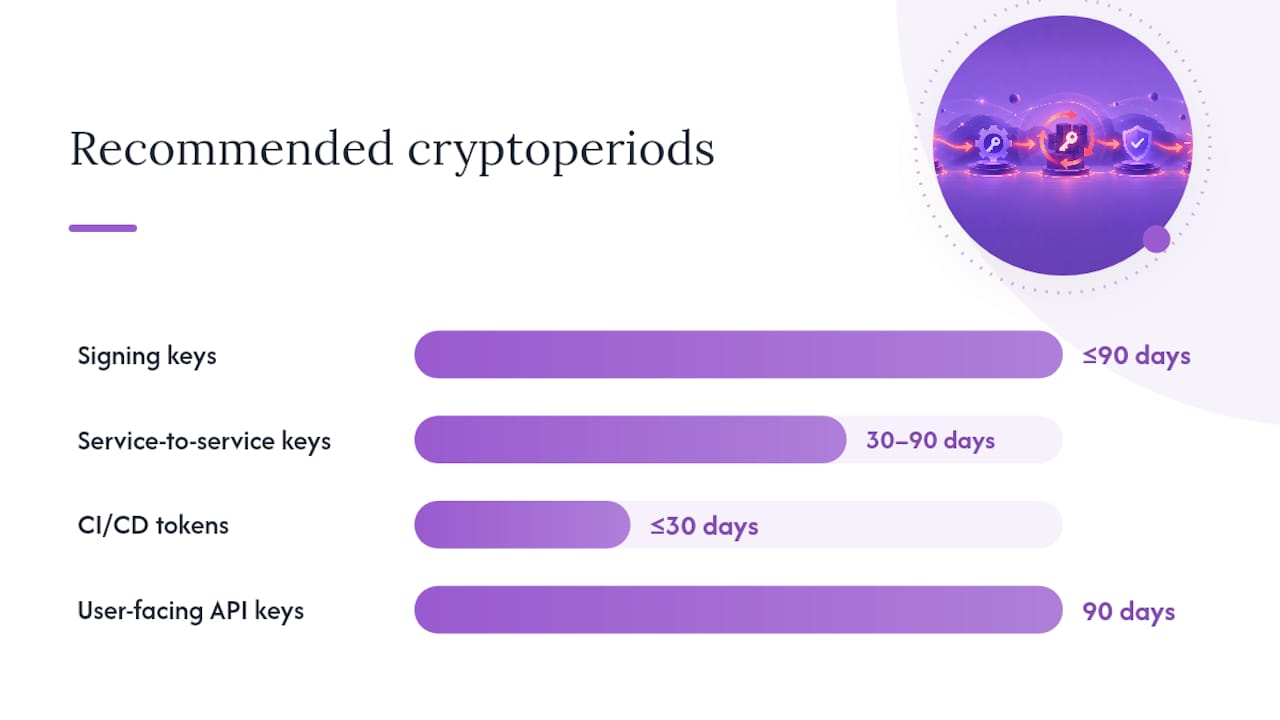
Not every credential deserves the same rotation clock. NIST IR 8587 recommends capping the active usage period for high-impact signing keys at 90 days, and shortening that window further for systems with greater blast radius if compromised.
A sensible cadence by credential type:
- Signing keys / high-impact certificates: 90 days or less, per NIST guidance
- Service-to-service API keys: 30 to 90 days, depending on scope
- CI/CD tokens: 30 days or shorter, since these often carry deploy-level access
- User-facing API keys: 90 days, with immediate rotation on any suspected exposure
The general rule: the more damage a leaked credential could do, the shorter its cryptoperiod should be. Manual rotation on a 30-day cycle is realistic for a handful of keys. Once you’re managing dozens of services, that same cadence becomes unsustainable without automation, which is exactly why NIST frames automated rollover as the default, not the exception.
Where to Store Keys: Secret Managers vs. Ephemeral Credentials
A rotation policy is only as good as the system enforcing it. Spreadsheets and shared .env files can’t version secrets, log access, or trigger a rotation hook, which makes them a poor foundation for anything beyond a side project.
Look for four capabilities before you pick a storage layer:
- Versioning: the ability to hold a current and previous secret simultaneously
- Rotation hooks: built-in triggers that run your rotation function on a schedule or event
- IAM scoping: granular permissions so the rotation agent can’t read every secret in the vault
- Audit logs: a record of who accessed or rotated what, and when
Three tools consistently meet that bar: AWS Secrets Manager, which handles native rotation Lambdas for RDS and custom secrets; HashiCorp Vault, which supports dynamic secrets that expire automatically; and cloud-native KMS offerings tied to IAM roles.
Where the architecture allows it, skip static keys entirely. AWS STS temporary credentials and managed identities on Azure or Google Cloud issue tokens that expire in minutes or hours, so there’s nothing long-lived to rotate at all.
Pro Tip: If a service supports workload identity or short-lived tokens, use that instead of a static key you have to remember to rotate. The best rotation strategy is often no static secret to rotate.
The Create, Set, Test, Finish Rotation Pattern
Every reliable rotation workflow follows the same four phases, whether it runs on AWS Secrets Manager, Vault, or a custom script.
- Create: generate a new secret version without touching the one currently in use.
- Set: push the new credential to the dependent service or downstream config store.
- Test: run integration checks confirming the new secret actually authenticates successfully.
- Finish: promote the new secret to active, and revoke or schedule deletion of the old one.
The step most teams skip is the transition window between “set” and “finish.” Portkey’s rotation documentation illustrates this well: it keeps the previous secret valid for a configurable period, enforcing a maximum of two active secrets at once, so in-flight requests using the old key don’t fail mid-rotation.
| Trigger type | Best fit | Typical permission model |
|---|---|---|
| Scheduled | Predictable cadence (30/90-day keys) | Rotation role scoped to one secret path |
| Event-driven | Compromise detected, employee offboarding | Elevated but time-boxed, revoked after run |
| Manual | One-off audits, new service onboarding | Human approval plus MFA required |
The rotation agent itself should hold the narrowest permission set possible: write access to one secret, nothing broader.
Implementation Checklist and a Serverless Rotation Example
Before automating anything, run through this checklist:
- Back up the current secret and confirm rollback is actually tested, not theoretical.
- Build an integration test harness that validates the new credential against a real endpoint.
- Create a rotation IAM role scoped to exactly one secret, nothing else.
- Add logging hooks so every rotation event lands in your audit trail automatically.
A common pattern uses a Lambda-style function triggered directly by the secret manager’s rotation event, mirroring the create/set/test/finish flow: the function creates a new version, updates the target service’s stored credential, runs a lightweight health check, then finishes by marking the new version current and scheduling the old one for deletion. This pattern shows up repeatedly across provider documentation and community tutorials.
Watch for three recurring failure points: cached credentials in application memory that don’t pick up the new key until a restart, rate limits on the provider’s key-creation endpoint if you rotate too many secrets in one batch, and stale clients that hold onto a revoked key past the transition window.
Pro Tip: Give yourself at least 30 minutes of dual-secret overlap on any production rotation. Anything shorter risks killing requests that were already in flight when the old key expired.
Monitoring, Auditing, and the Mistakes That Undermine Rotation
Rotation without monitoring just moves the risk around instead of removing it. Every rotation event should log who or what triggered it, a masked version of the old and new key, the rotation mode (scheduled, manual, emergency), and the outcome.
Watch for these misuse signals:
- A sudden spike in request volume from a single key
- API calls originating from IPs or regions the key has never used before
- Requests authenticated with a key that should already be expired
Statistic to note: OWASP’s Non-Human Identities project identifies long-lived, unrotated secrets as one of the most common contributing factors in credential-related breaches, largely because organizations lose track of where those secrets live.
That last point is the real operational failure mode: secrets sprawl. Run repository scans for hardcoded keys, block secrets from leaking into CI logs, and maintain automated discovery so no credential exists outside your inventory.
Chaingateway and Bitblade’s Practical Notes for Developers
Chaingateway’s API relies on HMAC-signed webhook requests, so every payload can be verified without exposing a raw credential in transit. That design choice matters for rotation strategy: if your webhook secret ever needs to change, verify the new signature works in a staging environment before you cut over production traffic.
A few habits worth carrying into any blockchain API integration:
- Keep separate keys for development, staging, and production. Never share one across environments.
- Store keys in a proper secret manager, not in application config committed to version control, following the guidance in Chaingateway’s security tips for blockchain API use.
- Scope each key to the minimum permission it actually needs.
When Static API Keys Stop Making Sense
Static keys work fine for low-risk internal tools. Once you’re exposing an API to external partners or handling financial data, the conversation shifts toward OIDC or JWT-based auth with short expirations. Start the migration on one low-traffic service, confirm your rotation automation holds under real traffic, then expand. An organization-wide rotation policy, enforced rather than suggested, tends to be the single biggest operational improvement a security team makes in a year.
— Bitblade
A Simpler Path: Reducing Credential Friction With Chaingateway
Chaingateway removes a chunk of the rotation burden by design, rather than asking you to bolt automation onto a patchwork of chain-specific endpoints. Its unified REST API covers Ethereum, Bitcoin, Tron, Solana, Polygon, BNB Chain, and Arbitrum through one authentication layer, so you’re not managing separate credential lifecycles for every chain you support.

Webhook payloads use HMAC-signed requests by default, and the platform’s automatic gas estimation and pre-decoded transaction data mean fewer moving parts for your rotation and monitoring scripts to track. If you’re building wallet creation, token transfers, or payment notifications into an app, the Blockchain API page walks through the endpoints, and the webhooks feature covers real-time event delivery in more depth. Plans start at the Plus tier for €49 per month, scaling up through Pro, Premium, and Enterprise as your usage grows. Check the pricing page and start a trial to see how the API handles your key management before committing to a plan.
Sources
- Protecting Tokens and Assertions from Forgery, Theft, and Misuse: Implementation Recommendations for Agencies and Cloud Service Providers (NIST IR 8587)
- Secrets Management Cheat Sheet — OWASP
Recommended
Frequently asked questions
Rotating an API key means generating a new credential to replace an active one, then retiring the old one once every dependent system has switched over. Done properly, it happens through an automated create/set/test/finish cycle rather than a manual swap, with a brief overlap window where both keys work.
It depends on the key’s risk level: NIST recommends capping high-impact signing keys at 90 days or less, while lower-risk service keys can often run 90 days safely if monitored. CI/CD tokens and anything with broad access should rotate closer to every 30 days.
Rotation limits how much damage a leaked or stolen credential can do, since it narrows the window during which that key remains valid. OWASP identifies long-lived, unrotated secrets as a recurring factor behind credential-related security incidents.
Automate the process end to end using a secret manager like AWS Secrets Manager or HashiCorp Vault, follow the create/set/test/finish pattern, and keep a transition window where both the old and new key work briefly. This avoids the downtime that comes from cutting over instantly across every dependent service.
Yes. Chaingateway signs webhook payloads with HMAC signatures so you can verify authenticity without exposing raw credentials in transit, and its unified API structure means one authentication layer to manage instead of a separate one per blockchain.
Ready to build this yourself? Get your API key — 7-day trial, no card required — or see the Blockchain API for the full endpoint reference.