Handle 500 item batches: ERC-721 vs ERC-1155 for developers
Compare ERC-721 ownership vs ERC-1155 balances, event shapes, and metadata substitution. See common indexer pitfalls and when a unified API cuts...
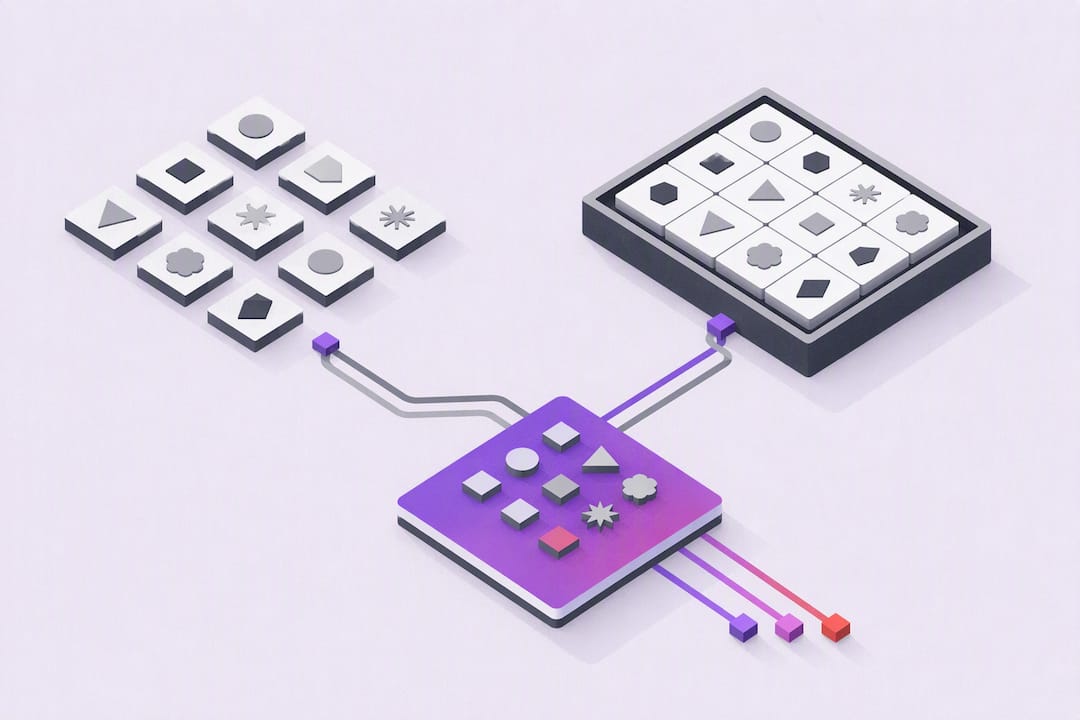
Pick ERC-721 when every token is a distinct, one-of-one asset and you want the broadest tooling support with the least custom logic. Pick ERC-1155 when your system needs many token types (currencies, editions, skins, tickets) in one contract with native batch minting and transfers. Both require careful planning around receiver hooks and indexing, since the two standards emit different events and expect different balance queries.
TL;DR:
- ERC-1155 supports batch transfers and multiple token types in one contract, making it more gas-efficient for large or mixed-token collections, but adds complexity to client logic.
- ERC-721 provides a simple, universally supported model with unique, one-to-one asset ownership, ideal for high-value art and collectibles where provenance matters more than efficiency.
- Supporting both standards requires managing different event types and data models, with a unified API simplifying transfer processing and reducing development time.
- Batch transfer savings depend heavily on actual transaction size and implementation details, so profiling gas costs on your network before decision-making is essential.
- Proper receiver hook testing and metadata handling are critical to avoid asset locking issues and ensure correct display and indexing in marketplaces.
Table of Contents
- ERC-721 vs ERC-1155: How the Contracts Actually Differ
- Key Differences and Trade-Offs You Need to Design Around
- Weighing the Benefits and Challenges of Each Standard
- Where Each Standard Actually Gets Used
- What Marketplace and Indexing Support Actually Requires
- A Practical Checklist Before You Ship
- How a Unified API Cuts Integration Time for Both Standards
- Choosing a Standard Comes Down to Prototyping Early
- Skip the Node Management, Keep the Flexibility
- Sources
- FAQ
ERC-721 vs ERC-1155: How the Contracts Actually Differ
The core split comes down to accounting. ERC-721 assumes one token, one owner, one ID. Every call to ownerOf(tokenId) returns a single address, transfers run through transferFrom or safeTransferFrom, and approvals are granted per token or per operator. Metadata comes from the optional tokenURI(tokenId) extension defined in EIP-721.
ERC-1155 assumes amounts, not ownership in the singular sense. balanceOf(account, id) tells you how many units of a given token ID an address holds, and balanceOfBatch lets you query several accounts and IDs in one call. Transfers move through safeBatchTransferFrom, and metadata resolves through uri(id), where clients substitute the token ID into a {id} placeholder in the URI string, per EIP-1155.
Both standards enforce safe-transfer checks on contract recipients. ERC-721 calls onERC721Received; ERC-1155 calls onERC1155Received for single transfers and onERC1155BatchReceived for batch transfers. If a receiving contract doesn’t implement the correct hook, the transfer should revert rather than lock the asset in a contract that can’t move it. Test this path explicitly. It’s the most common source of “stuck NFT” support tickets in production marketplaces.

Key Differences and Trade-Offs You Need to Design Around
The interface differences ripple into architecture decisions that are hard to reverse after launch.
Contract structure. ERC-721 collections typically deploy one contract per collection, with each token ID representing a unique item. ERC-1155 deploys one contract that can hold hundreds or thousands of token types, each with its own supply and metadata. That single-contract model cuts deployment overhead when you’re launching many token types at once.
Gas and batching. ERC-1155’s safeBatchTransferFrom moves multiple token IDs and amounts in a single transaction, which generally lowers gas cost per item compared to firing off individual ERC-721 transfers. But the real savings depend on batch size, storage slot changes, and how your minting logic writes state, according to OpenZeppelin’s ERC-1155 documentation. Profile actual gas costs on your target network before assuming batching wins.
Metadata handling. ERC-721’s tokenURI(tokenId) returns a full, unique URI per token. ERC-1155’s uri(id) pattern returns a template string with {id} left for client-side substitution, which means your front end or indexer has to do that substitution and cache the result correctly.
Semantics. ERC-1155 items are still amount-based even when supply equals one. Treat a “1-of-1” ERC-1155 token as a special case of a fungible-style balance, not as an ERC-721-style owned object. This matters for anyone writing escrow, staking, or marketplace logic that assumes a single, unambiguous owner.
- ERC-721: one owner per token ID, checked via
ownerOf. - ERC-1155: balances per (account, id) pair, checked via
balanceOf. - ERC-721 events:
Transfer. ERC-1155 events:TransferSingleandTransferBatch.
Pro Tip: Never assume a batch transfer maps cleanly to N separate transfer records. TransferBatch events carry parallel arrays of IDs and values, and reconstructing per-item history requires zipping those arrays correctly in your indexer, not treating the event as a loop of single transfers.
Weighing the Benefits and Challenges of Each Standard
ERC-721’s biggest strength is how little you have to explain. Every marketplace, wallet, and analytics tool already knows what ownerOf means, and metadata mapping is straightforward: one token, one JSON file. The tradeoff shows up the moment you need to move many tokens at once. Without batch functions, minting or transferring 500 items means 500 separate transactions, each paying full transaction overhead.
ERC-1155 flips that trade. Batch minting and batch transfers make it efficient for mixed-token systems, and deploying one contract for an entire item catalog beats deploying dozens of ERC-721 contracts. The cost lands on your client code: every call needs an ID and often an amount, marketplaces sometimes handle 1155 listings differently than 721 listings, and URI substitution adds a step most junior developers get wrong on the first pass.
- ERC-721 pros: simple mental model, near-universal support, clean one-to-one metadata.
- ERC-721 cons: no native batching, higher aggregate gas for multi-token flows.
- ERC-1155 pros: batch operations, lower per-collection deployment overhead, flexible supply models.
- ERC-1155 cons: more complex client logic, uneven marketplace support, metadata substitution to implement correctly.
Where Each Standard Actually Gets Used
Real product decisions tend to fall into a handful of recurring patterns in real estate tokenization.
- One-off art and high-value collectibles. A generative art drop or a single signed digital painting fits ERC-721 because provenance tracking and universal wallet display matter more than gas efficiency.
- Game inventories. Currencies, consumables, crafting materials, and cosmetic skins are a natural fit for ERC-1155, since a single contract can represent dozens of item types and batch operations handle inventory updates in one transaction.
- Ticketing and editions. A concert with general admission, VIP, and backstage tiers maps cleanly to ERC-1155, where each tier is a token ID with its own supply cap.
- Large airdrops and marketplace catalogs. Distributing thousands of items to thousands of wallets favors ERC-1155’s batch transfers for gas efficiency, though you should still test how your target marketplaces render and list 1155 items before committing, as recent comparisons of the two standards point out in this ERC-721 vs ERC-1155 explainer.
What Marketplace and Indexing Support Actually Requires
Supporting both standards in a marketplace or analytics stack means building two different data models, not one.
Indexers need to process TransferSingle and TransferBatch separately from ERC-721’s simpler Transfer event, and they need to maintain running balances per (id, account) pair for every ERC-1155 collection they track. Skipping this and trying to reconstruct ownership after the fact from raw logs is a common source of subgraph bugs.
- Normalize transfer events into a shape your API can serve consistently, regardless of which standard emitted them.
- Choose an endpoint model that reflects the actual semantics: an
ownerOfstyle query for ERC-721, abalanceOfstyle query for ERC-1155. - Test approval and listing flows against your actual target marketplaces rather than assuming they behave identically.
- Expect search and discovery to differ: ERC-1155 collections often need per-ID facets rather than a flat token list.
A Practical Checklist Before You Ship
Run through this sequence before any mainnet deployment.
- Confirm interface support with ERC-165, including a
supportsInterface(0x4e2312e0)check for any contract expected to receive ERC-1155 tokens. - Profile gas across representative batch sizes; a batch of 5 behaves very differently than a batch of 500.
- Implement metadata substitution for
uri(id)and build a cache invalidation strategy for when metadata changes. - Write integration tests covering approvals, escrow contracts, staking flows, and marketplace listings, with explicit coverage for
TransferBatchhandling. - Check whether your deployed contracts support permit-style approvals before relying on them. This functionality is still an extension proposal under EIP-7604, not a default feature of either standard.
Pro Tip: Write your receiver-hook tests first, before your happy-path transfer tests. Most production incidents with both standards trace back to a contract that couldn’t accept the asset it was sent, not a bug in the transfer logic itself.
How a Unified API Cuts Integration Time for Both Standards
Building parsers for TransferSingle, TransferBatch, and Transfer events by hand takes real engineering time, and getting the array handling wrong on batch events is an easy mistake to repeat across projects. A unified blockchain API that pre-decodes these events into a normalized payload removes that parsing step entirely, regardless of which standard emitted the original log.
Automatic gas estimation and built-in wallet management also matter here: minting and transferring across ERC-721 and ERC-1155 collections both require accurate gas prediction, especially for batch calls where gas scales with array size. Pairing that with HMAC-signed webhook notifications means your production systems stay in sync with on-chain state without running your own node infrastructure.

Choosing a Standard Comes Down to Prototyping Early
Match your token accounting model to your asset model before writing production code, not after. Prioritize tests that expose gas and indexing costs early. A unified API can absorb much of the integration plumbing that eats sprint time during marketplace launches.
— Bitblade
Skip the Node Management, Keep the Flexibility
A unified API can provide token and NFT transfer capabilities across multiple chains instead of requiring separate integrations for every network. Such APIs may offer pre-decoded transfer data, automatic gas estimation, and secure wallet creation without needing your own infrastructure for either ERC-721 or ERC-1155 collections.
That matters most the moment your product needs to support both standards side by side: a marketplace with unique art alongside mixed-token game items, for instance. Instead of writing separate event parsers and gas estimators for each contract type, Chaingateway’s Blockchain API normalizes transfer data and pairs it with webhook notifications so your backend gets real-time updates without polling. HMAC-signed requests keep those webhooks verifiable in production. If you’re evaluating fit, check the pricing plans starting with the Plus tier at €49 per month, and see whether offloading node management frees up your engineering time for the parts of the product only you can build.
Sources
Start with EIP-721 and EIP-1155 for the canonical specs, OpenZeppelin’s ERC-1155 docs for implementation patterns, and EIP-7604 for permit-style approval proposals. For deeper context on the broader token ecosystem, see this Ethereum gas and token overview.
Recommended
Frequently asked questions
ERC-721 tokens are non-fungible tokens where each token ID represents one distinct, individually owned asset, tracked through ownerOf(tokenId). The standard defines transfer functions, approval mechanics, and an optional metadata extension for tokenURI, as specified in EIP-721.
ERC-1155 is generally the better fit for smart contracts managing multiple token types, since one contract can hold many token IDs with native batch transfer and batch balance functions. ERC-721 remains the stronger choice when every asset is meant to be strictly unique and tracked individually.
No. Ethereum and BNB Chain each have their own fungible token standards with similar interfaces but different networks and separate deployments, which is why cross-chain token transfers require bridging or a multi-chain API rather than a direct swap.
Yes, but your indexer and API need to handle both event models: Transfer for ERC-721 and TransferSingle/TransferBatch for ERC-1155. A unified API like Chaingateway’s Blockchain API can normalize both into a consistent payload so your application logic doesn’t need separate code paths for each standard.
Not always. Batch operations tend to lower per-item gas cost, but actual savings depend on batch size, storage writes, and network conditions, according to OpenZeppelin’s documentation. Profile gas on your specific contract and transaction patterns rather than assuming a fixed savings percentage.
Ready to build this yourself? Get your API key — 7-day trial, no card required — or see the Blockchain API for the full endpoint reference.