Developer: Ship Recurring Crypto Payments in 90 Days, EIP & 2026
Developer-facing blueprint to pilot recurring crypto payments: choose EIP-safe contracts, follow 2026 US reporting rules, and deploy a Chaingateway-backed...
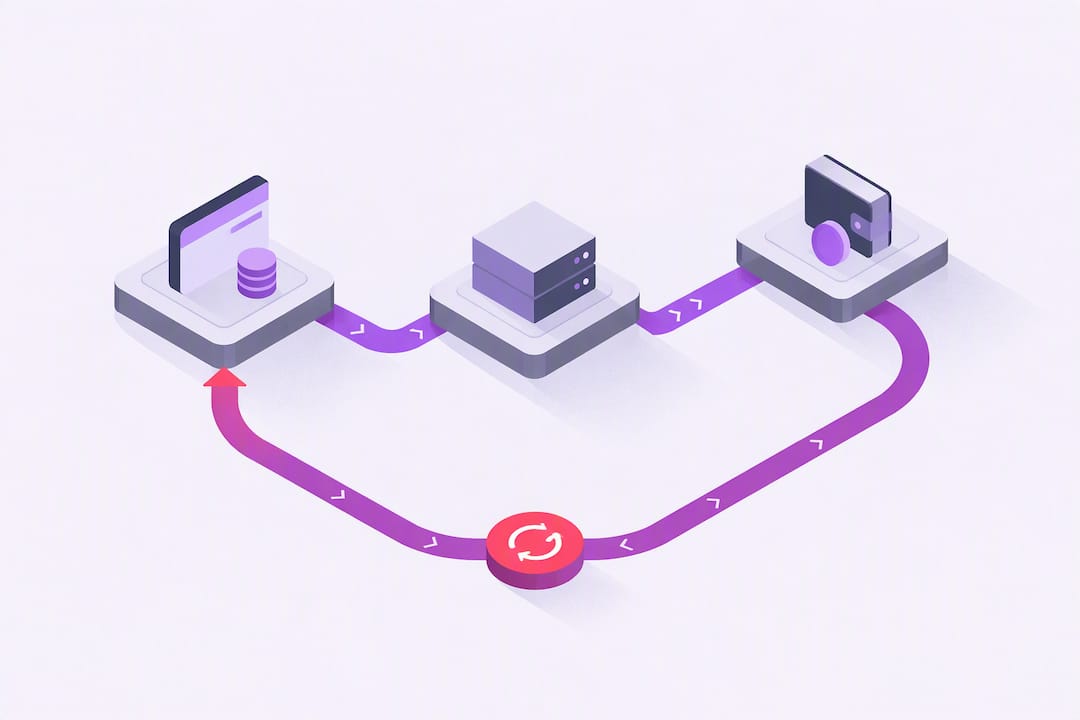
Recurring crypto payments are automated on-chain or hybrid billing flows, and for most subscription businesses the right build is a stablecoin on a Layer 2 network, paired with a bounded allowance or escrow contract, an offchain scheduler, and webhook monitoring for every state change. The main risks are gas cost spikes, token price swings between invoice and settlement, and new U.S. broker tax reporting rules that now apply to digital-asset processors. Get the architecture right first. Everything else is tuning.
TL;DR:
- Using stablecoins on Layer 2 networks like Polygon or Arbitrum minimizes gas costs and enhances fee predictability for recurring crypto payments.
- Managed automation services such as Chainlink or Gelato are recommended for reliable scheduling, while self-run relayers require more infrastructure overhead.
- Implementing expiring or renewable allowances and permit-based approvals reduces fraud risk and liability from unlimited permissions.
- Webhook verification with HMAC and real-time permission monitoring are crucial to promptly detect revocations or suspicious activity and prevent failed payments.
- Businesses must prepare for 2026 tax reporting changes by accurately tracking and reconciling crypto, USD, and fiat amounts for each transaction to ensure compliance.
Table of Contents
- How Do Recurring Crypto Payments Actually Work?
- Which Implementation Pattern Should You Actually Build?
- What Contract Standards Make Recurring Pulls Safe?
- How Do You Keep Recurring Billing Secure and Reliable?
- What Are the Tax and Compliance Rules for 2026?
- What Does a Chaingateway Integration Checklist Look Like?
- Should Your Business Actually Use Recurring Crypto Billing?
- What a Sensible Pilot Looks Like
- Get Recurring Crypto Billing Running Without Managing Nodes
- Sources
- FAQ
How Do Recurring Crypto Payments Actually Work?
Nobody has built a native “subscription” primitive that every blockchain supports out of the box, so recurring crypto billing is really three architectures wearing different clothes.
Prepaid or escrow release locks funds in a smart contract upfront, then releases fixed amounts on a schedule. It works well for known-term contracts (a 12-month SaaS plan) because the customer’s exposure is capped and the merchant doesn’t need to touch their wallet again until the term ends.
Offchain presigned or pull approvals flip that model. The customer grants a spending allowance, and the merchant (or a scheduler acting for the merchant) pulls funds at each billing cycle. This mirrors how ACH debit already works, which is part of why it’s the pattern most billing teams gravitate toward.
Continuous streaming pays per second or per block instead of per cycle, useful for usage-based pricing but rarely worth the added contract complexity for a standard monthly subscription.
Almost none of these run purely onchain, because most chains have no native concept of “wait 30 days and try again.” That job falls to an offchain scheduler or relayer, which is why recurring crypto payments generally combine smart contracts with offchain triggers rather than pure onchain logic.
The runtime sequence looks like this in production:
- Authorization: the customer signs an allowance, permit, or funds an escrow contract.
- Scheduling: a scheduler registers the next execution time and the conditions to check (balance, allowance, gas price).
- Execution: at the trigger time, the scheduler submits the pull or release transaction.
- Notification: a webhook fires to the merchant’s backend confirming success, failure, or a retry.
- Reconciliation: the merchant matches the onchain event to the internal invoice and updates the customer’s account.
Who pays gas is a real design decision, not an afterthought. Some merchants absorb it into their margin, some pass it to the customer as a network fee line item, and some run a hybrid where a merchant-funded buffer wallet covers gas while the customer’s stablecoin balance covers the invoice amount. The hybrid model tends to produce the fewest support tickets, because customers never see a failed payment caused by an empty gas tank on a token they didn’t know they needed.
Which Implementation Pattern Should You Actually Build?
Stablecoins are the default for a reason: a $29 monthly invoice needs to still be worth roughly $29 when it settles. Stripe’s technical guidance treats stablecoins as the practical baseline for recurring billing because they cut out the accounting mess of translating fluctuating token values into consistent revenue lines. If your business ever touches a volatile asset for billing, convert to a stablecoin or fiat equivalent immediately at receipt, and record the conversion event separately from the invoice event. Do not let a single ledger entry try to represent both.
Network choice is where most teams either save themselves years of pain or create it. Layer 2 networks such as Polygon, Base, Arbitrum, and Optimism offer materially lower and more predictable gas than Ethereum mainnet, while keeping most of the same tooling and wallet compatibility developers already know. A pragmatic default is to pilot subscriptions on an L2 and reserve mainnet settlement for high-value, low-frequency transfers where the gas cost is a rounding error.
For scheduling, you have two real choices:
- Managed automation networks (Chainlink Automation and Gelato-style relayer services) handle the “wake up and execute” problem for you, with built-in monitoring and predictable SLAs.
- Self-run relayers give you more control but mean you own uptime, retry logic, and gas-price monitoring yourself.
Most teams outside of large enterprises are better served by managed automation. The reliability engineering isn’t the differentiator your product needs.
Build retries with idempotency keys from day one. A transaction that appears to fail because of a slow confirmation, then gets retried blindly, can double-bill a customer. Attach a unique idempotency key to each billing cycle attempt so a retried execution recognizes it already succeeded.
Pro Tip: Set your retry backoff to match block confirmation times on your chosen network, not a fixed interval. Retrying every 30 seconds on a chain with 2-minute finality just spams failed transactions and burns gas.
What Contract Standards Make Recurring Pulls Safe?
Vanilla ERC-20 allowances were never designed for recurring billing, and it shows. An unlimited approval, the pattern most dApps default to for convenience, gives a merchant contract permission to pull any amount, at any time, forever, until the customer manually revokes it. If that contract is ever compromised, the blast radius is the customer’s entire token balance.
Two categories of newer standards fix this at the primitive level:
- Renewable allowances, described in specs like EIP-8255, set a continuous recovery rate instead of a lump sum, similar to how a subscription refills a spending cap gradually rather than granting it all at once.
- Expiring approvals (a pattern also covered under EIP-8255 and related proposals like ERC-5827) attach a hard expiration timestamp to an allowance, so a forgotten or abandoned approval can’t sit active for years.
- Permit-based flows (the ERC-2612 pattern) bundle the approval and the spend into a single signed message, cutting one onchain transaction out of every billing cycle and reducing the gas customers indirectly pay for.
The security literature on this is blunt: designing for revocation and expiry reduces liability far more effectively than any amount of monitoring can, because it caps the maximum possible loss before an incident even happens. If your billing contract still defaults to unlimited approvals in 2026, that’s a design decision to revisit, not a technical necessity.
Streaming primitives, which calculate payment per second or per block, solve a different problem (usage billing) but come with a tradeoff: settling that frequently onchain is expensive, so most streaming implementations batch settlement rather than writing every second to the chain.
How Do You Keep Recurring Billing Secure and Reliable?
The single most important operational habit is making your billing system permission-revocation aware. If a customer revokes their allowance, your system needs to know within seconds, not discover it three failed pulls later. Stripe’s guidance on this is direct: track allowance and approval status continuously and tie it into your access control layer, so a revoked permission pauses the customer’s access immediately instead of leaving them in billing limbo.
Key management deserves the same rigor you’d give a bank’s back office:
- Use multisig wallets for treasury funds that hold customer revenue.
- Keep automation and relayer keys on hardware security modules, separate from any key with treasury access.
- Build a manual fallback path for when automation infrastructure is down, even if it’s slower.
Webhooks are your nervous system for this whole operation, so sign every payload with HMAC and verify signatures on receipt. Reject anything that doesn’t match, and build replay protection so a captured webhook payload can’t be resent to trigger a duplicate action. Give your system an instant pause or lock capability for any account showing suspicious behavior, like a sudden allowance change from an unrecognized address.
Fraud runs in the other direction too. The FTC has documented a sharp rise in scammers impersonating legitimate businesses to request crypto payments outside normal channels. Train your support team to recognize the pattern, and make it a habit to tell customers plainly: legitimate billing never asks them to send funds manually outside your app’s approval flow.
Pro Tip: Publish your merchant wallet addresses on a verified, static page and tell customers to check that address before approving any allowance. Scammers rely on customers not double-checking.
What Are the Tax and Compliance Rules for 2026?
U.S. tax treatment of recurring digital-asset payments changed in a way that directly affects processors, not just individual traders. Brokers, a category that can include payment processors depending on how they structure custody and settlement, must file Form 1099-DA for transactions starting January 1, 2025, with expanded basis-reporting requirements phasing in for 2026. If your business touches customer digital-asset payments at any scale, this isn’t optional homework.
The Form 1099-DA instructions lay out de minimis thresholds for what the IRS calls a Digital Asset Payment Processor (PDAP), along with specific rules for qualifying stablecoin transactions. Whether your recurring billing service counts as a broker under these rules depends on factors like whether you take custody of funds and how settlement flows through your systems, so this determination is worth a conversation with counsel rather than a guess.
A processor that never takes custody and simply facilitates a direct wallet-to-wallet pull sits in a different regulatory position than one that holds customer balances before forwarding them. That distinction, custodial versus noncustodial, is often the hinge point for whether broker reporting applies at all.
KYC and AML obligations follow a similar split. Custodial architectures generally carry heavier verification requirements because the processor is holding customer funds at some point in the flow. Noncustodial pull-based models reduce that exposure but still warrant audit logs covering every allowance grant, revocation, and execution, since regulators and auditors alike will ask for that trail eventually.
For bookkeeping, record three things separately for every transaction: the billing currency amount, the crypto amount actually received, and the USD equivalent at the moment of receipt. Brokers must furnish payee statements by February 17, 2026 for 2025 transactions, so your reconciliation pipeline needs to produce clean per-customer totals well before that date, not scramble for them in January.

What Does a Chaingateway Integration Checklist Look Like?
A working pilot comes down to six decisions, made in order:
- Choose token and network. Default to a major stablecoin on an L2 unless you have a specific reason not to.
- Design the authorization model. Bounded allowance for predictable recurring amounts, escrow for fixed-term contracts.
- Pick a scheduler. Managed automation unless you have dedicated infrastructure staff to run relayers.
- Implement execution with retries. Idempotency keys, backoff tuned to your chain’s confirmation time.
- Wire up real-time webhooks with HMAC verification. Every state change (success, failure, revocation) needs a signed event.
- Build reconciliation and tax logging. Per-customer totals, USD equivalents at receipt, audit trail for every allowance event.
Chaingateway’s Blockchain API covers the technical surface of steps one through four with a single REST interface across Ethereum, Tron, Polygon, Solana, BNB Chain, Arbitrum, and Bitcoin, so you’re not stitching together separate SDKs per chain. Wallet creation is handled through the same API, gas estimation runs automatically on each transaction, and every request is secured with HMAC signing.
For step five, Chaingateway’s webhook system delivers pre-decoded event payloads, meaning your backend doesn’t need to parse raw blockchain data to know a payment succeeded, failed, or an allowance changed. A hands-on example of wiring this into an application is in the Laravel integration walkthrough, which walks through receiving and reacting to live payment events.

Should Your Business Actually Use Recurring Crypto Billing?
Recurring crypto payments settle globally without a card network sitting in the middle, which matters most for businesses serving customers in regions with limited banking access or high card-decline rates. Stablecoin-denominated invoices give you far more revenue predictability than a volatile token would, and settlement finality tends to be faster than a multi-day ACH cycle.
The tradeoffs are real, though:
- Token volatility is a nonissue if you stick to stablecoins, but a live risk the moment you accept anything else.
- Gas costs can spike unpredictably on the wrong network, which is exactly why L2 selection matters as much as it does.
- Customer education is a genuine cost. Most subscribers have never approved a token allowance before, and a confusing wallet prompt kills conversions.
- Regulatory complexity, especially the 2026 reporting changes, adds real operational overhead for finance teams.
Mitigate each one directly rather than hoping it doesn’t matter. Use L2s for fees, keep a merchant-funded gas buffer, offer a hybrid fiat fallback for customers who bounce off crypto onboarding, and send a clear receipt after every successful cycle. Ambiguity is what erodes trust here, not the technology itself.
What a Sensible Pilot Looks Like
Pick one L2, one stablecoin, and one customer segment. Instrument webhooks and reconciliation from the first transaction, not after you scale, and track two numbers religiously: payment success rate and time spent on manual accounting reconciliation per cycle. If either number looks bad after 90 days, you’ve found your bottleneck before it became expensive.
Loop legal and finance into scoping before you write contract code, not after. The custodial versus noncustodial decision shapes your KYC obligations and your Form 1099-DA exposure, and that’s a far cheaper conversation to have on a whiteboard than inside a contract you already shipped. For the engineering side, pre-decoded webhooks and automatic gas estimation save real debugging hours precisely because gas estimation failures are one of the most common causes of silent recurring-payment breakage.
— Bitblade
Get Recurring Crypto Billing Running Without Managing Nodes
Building the architecture above from scratch means running your own nodes, decoding raw transaction data, and hand-rolling HMAC signing for every webhook you send. Chaingateway replaces that with one REST API across seven chains, so your team ships a pilot in days instead of the months it takes to build multi-chain infrastructure internally.
The Blockchain API handles wallet creation, token transfers, and automatic gas estimation, while Chaingateway Webhooks deliver pre-decoded, HMAC-signed event payloads the moment a payment succeeds, fails, or an allowance changes. That combination covers steps two through five of the integration checklist without you writing chain-specific code for each network you support.
Plans start at the Plus tier at €49 per month, scaling up through Pro, Premium, and Enterprise as your transaction volume grows. Check the pricing page for current plan details and start a trial to see how quickly a working recurring billing pilot comes together.
This article is general information, not a substitute for advice from a qualified financial advisor. Consult a qualified financial professional about your own circumstances before acting on anything here.
Sources
- How Recurring Crypto Payments Work | Stripe
- Digital assets | Internal Revenue Service
- FTC data spotlight: bitcoin ATMs and payment portal scammers
Recommended
Frequently asked questions
The IRS doesn’t monitor wallets directly, but it does receive reporting from brokers and processors that file Form 1099-DA for digital-asset transactions starting with 2025 activity. If your business or a platform you use qualifies as a broker under the new rules, your transaction history is increasingly visible through those filings rather than through the blockchain itself.
The main drawbacks are gas cost volatility, token price risk if you’re not using a stablecoin, and the customer education burden of wallet approvals. Regulatory complexity adds a real layer of overhead too, particularly around the 2026 broker reporting changes that affect how processors handle tax documentation.
A legitimate recurring billing request never asks you to send funds manually outside your app’s normal approval flow, while scammers frequently impersonate real businesses to request payments that way. The FTC has tracked a sharp rise in these impersonation scams, so verify merchant wallet addresses against a published, static source before approving any allowance.
The strongest setup for most subscription businesses combines a stablecoin on a Layer 2 network with a bounded allowance, an automation layer for scheduling, and HMAC-signed webhooks for monitoring. Chaingateway builds that stack into a single multi-chain REST API with pre-decoded webhook events, cutting out the need to run separate infrastructure per blockchain.
Ready to build this yourself? Get your API key — 7-day trial, no card required — or see the Blockchain API for the full endpoint reference.