Webhooks vs WebSockets for Developers: Ingest, Queue, Fan Out Pattern
Developer-focused comparison of webhooks and WebSockets covering serverless fit, retry versus connection trade-offs, and the webhook→queue→WebSocket...
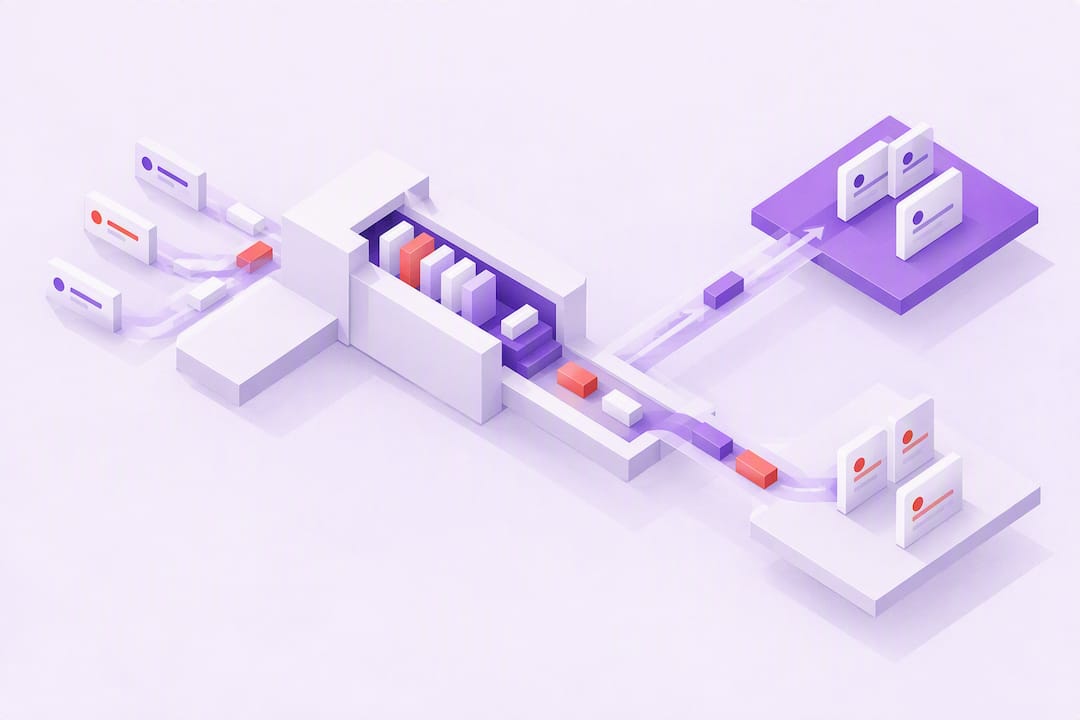
Webhooks are one-way HTTP event pushes triggered when something happens on a server; WebSockets are persistent, bidirectional connections that stay open for continuous two-way messaging. Pick webhooks for server-to-server notifications like payment confirmations or CI/CD triggers, and pick WebSockets when a browser or app needs live, interactive updates like chat or a trading dashboard. Many production systems use both: a webhook feeds your backend, then a WebSocket connection fans that event out to connected clients in near real time.
TL;DR:
- Webhooks are ideal for server-to-server notifications from third-party services, but require a public, reachable URL with secure signatures and quick responses.
- WebSockets are better suited for real-time, bidirectional communication with browsers or apps but demand connection management and state handling, including reconnection logic.
- Combining webhooks and WebSockets offers a resilient architecture: webhooks handle event ingestion, while WebSockets deliver live updates to clients efficiently.
- Scaling WebSockets involves managing many open connections with sticky sessions or a shared message broker, whereas webhooks scale easily via serverless, stateless processing with queues.
- Webhook security relies on rotating signatures and TLS; WebSocket security emphasizes connection authentication and per-message validation to prevent unauthorized access.
Table of Contents
- Webhooks Explained: How They Work for Developers
- WebSockets Tutorial: The Persistent Connection Model
- How Do Webhooks and WebSockets Compare Technically?
- When to Use Webhooks vs WebSockets: A Decision Checklist
- Scalability and Operational Considerations
- Security Differences and Recommended Defenses
- A Real Pattern: Webhooks Feeding WebSocket Fan-Out
- Default Choices and What to Watch Next
- Get Reliable Webhook Delivery Without Building It Yourself
- Sources
- FAQ
Webhooks Explained: How They Work for Developers
A webhook starts with registration. You give a provider (a payment processor, a Git host, a blockchain node) a URL, and when a relevant event fires, that provider sends an HTTP POST to your endpoint with a JSON payload describing what happened. No polling, no open connection sitting idle. It is event-driven push over standard HTTP, which is why it plugs so easily into architecture you already run.
The catch is delivery guarantees. Most webhook systems use at-least-once semantics: if your endpoint doesn’t return a 2xx response fast enough, the provider retries, sometimes for hours or days depending on its retry schedule. That means your handler has to be idempotent, capable of processing the same delivery twice without creating duplicate charges or duplicate database rows. Webhook retry behavior is the single most common source of subtle bugs in webhook integrations, because teams build handlers assuming exactly-once delivery when the protocol never promised that.
Because webhooks need a reachable URL, they also introduce their own operational checklist:
- A public endpoint that survives firewall and load balancer configuration
- Signature verification (usually HMAC) to confirm the request actually came from the provider
- Logging of delivery IDs so you can trace duplicates or gaps
- A response time fast enough to avoid triggering retries for a request you’re still processing
You’ll see webhooks behind payment confirmations, CI/CD pipeline triggers, Git push notifications, and deposit alerts. They’re also the natural fit for serverless backends, since there’s no connection state to keep alive between invocations.
WebSockets Tutorial: The Persistent Connection Model
A WebSocket connection starts life as a regular HTTP request, then upgrades. The client sends an Upgrade: websocket header, the server agrees, and from that point forward both sides can send messages over the same TCP connection without the overhead of a new HTTP request each time. That’s what makes it full-duplex: server and client push data whenever they need to, not just in response to a request.
The tricky part isn’t the handshake. It’s everything after. Connections drop, networks flake, tabs go to sleep. Client code needs reconnection logic, and you need to watch bufferedAmount to avoid piling up outbound messages faster than the socket can drain them. MDN’s WebSocket documentation covers this lifecycle in detail, including guidance to always use wss:// in secure contexts and to close sockets cleanly on page unload.
Server-side, WebSockets are stateful. Each open connection consumes a file descriptor and some memory, and if you’re running multiple server instances, you need sticky sessions or a message broker (Redis pub/sub, NATS) so a message published on one instance reaches a client connected to another.
Common use cases include:
- Chat applications and collaborative editors
- Live dashboards and stock tickers
- Multiplayer game state sync
- Presence indicators (“user is typing”)
If you’re building something with heavier backpressure needs or want stream-based APIs, keep an eye on WebTransport and WebSocketStream, both aimed at some of the rough edges in the classic WebSocket API, though browser support is still catching up.
How Do Webhooks and WebSockets Compare Technically?
| Property | Webhooks | WebSockets |
|---|---|---|
| Connection persistence | None, one request per event | Persistent, stays open |
| Direction / who initiates | One-way; provider initiates each push | Bidirectional; either side sends after handshake |
| Protocol / ports | HTTP/HTTPS, standard ports | ws/wss, upgraded from HTTP, standard ports |
| Statefulness | Stateless between calls | Stateful for connection lifetime |
| Delivery guarantees / retries | At-least-once, provider retries on failure | No built-in retry; app must handle drops |
| Who manage retries | Sending provider (with your idempotent handler) | Your client and server code |
| Typical latency / best for | Near real-time, fine for event notifications | Lowest latency, best for continuous interactivity |
| Security model | HMAC signatures, TLS, timestamp checks | TLS handshake (wss), per-connection auth token |
| Public endpoint requirement | Required, must be internet-reachable | Client connects out; no inbound endpoint needed |
| Typical use cases | Payments, CI/CD, deposits, order status | Chat, dashboards, multiplayer, presence |
The practical implication: webhooks push the delivery problem onto the sender (with retries you must handle idempotently), while WebSockets push the connection-management problem onto you. Neither is “easier” in the abstract. It depends on whether you’d rather write a stateless HTTP handler or run a stateful connection pool.
When to Use Webhooks vs WebSockets: A Decision Checklist
Run through these questions before you pick an architecture:
- Where does the event originate? If it’s a third-party system (a payment gateway, a blockchain network, a Git host), you need webhooks. You can’t open a WebSocket to a service you don’t control.
- How much latency can you tolerate? Sub-second UI updates favor WebSockets. A few seconds of delay for a backend record update is fine for webhooks.
- What’s the scale shape? Many independent event producers feeding one backend favors webhooks. One backend fanning updates to thousands of connected clients favors WebSockets.
- What’s your server topology? Serverless functions that scale to zero pair naturally with webhooks. If you’re already running long-lived stateful servers, WebSockets add less incremental complexity.
- Do firewall or network constraints block inbound connections? If your infrastructure can’t expose a public endpoint, WebSockets (which the client initiates outward) sidestep that problem entirely.
Mapped to scenarios: payment notifications and deposit alerts go to webhooks. Analytics event ingestion from external tools goes to webhooks. Chat and collaborative editing go to WebSockets. A live trading dashboard needs WebSockets for the last mile, even if the underlying price feed arrives via webhook.
Pro Tip: Start prototypes with webhooks plus simple polling on the frontend. It’s slower, but it lets you validate the event model before you invest in connection management. Add WebSockets once you’ve confirmed users actually need sub-second updates, not before.
Scalability and Operational Considerations
WebSockets change your capacity math. Every open connection holds a file descriptor and a slice of memory, and once you scale past one server instance, you need sticky sessions or a shared pub/sub layer so messages reach clients regardless of which instance they’re connected to. That’s real infrastructure, not a config flag.
Webhooks scale differently because they don’t hold state between calls, which is exactly why they suit serverless and scale-to-zero environments. A function spins up, processes the POST, and disappears.
At production volume, a few patterns keep both models sane:
- Route incoming webhooks through a queue (SQS, Pub/Sub, RabbitMQ) so a burst of events doesn’t overwhelm your handler
- Batch or debounce WebSocket broadcasts when many events fire in a short window
- Use dead-letter queues for webhook deliveries that fail idempotent processing repeatedly
- Monitor connection churn on WebSocket servers and retry-queue depth on the webhook side; both are early warning signs before customers notice anything
Security Differences and Recommended Defenses
Webhooks and WebSockets fail differently, so they need different defenses. Webhook security centers on proving the request is genuine: HMAC signatures in a header, a timestamp to block replay attacks, and strict TLS. WebSocket security centers on the connection itself: authenticate at connect time with a short-lived token, then validate every message afterward, since a single handshake authorizing an entire long-lived session is a real risk if you don’t re-check permissions per message.
Practical defenses worth building in from day one:
- Rotate HMAC secrets periodically and log every delivery attempt with its signature status
- Reject webhook payloads with stale timestamps to block replay
- Cap concurrent WebSocket connections per client and rate-limit message frequency
- Validate payloads server-side even after authentication, since a valid token doesn’t guarantee a valid message
Chaingateway’s own webhook infrastructure signs every request with HMAC and gives you a documented security workflow for rotating secrets without downtime, which matters more than most teams expect once they’ve been burned by a leaked signing key.
A Real Pattern: Webhooks Feeding WebSocket Fan-Out
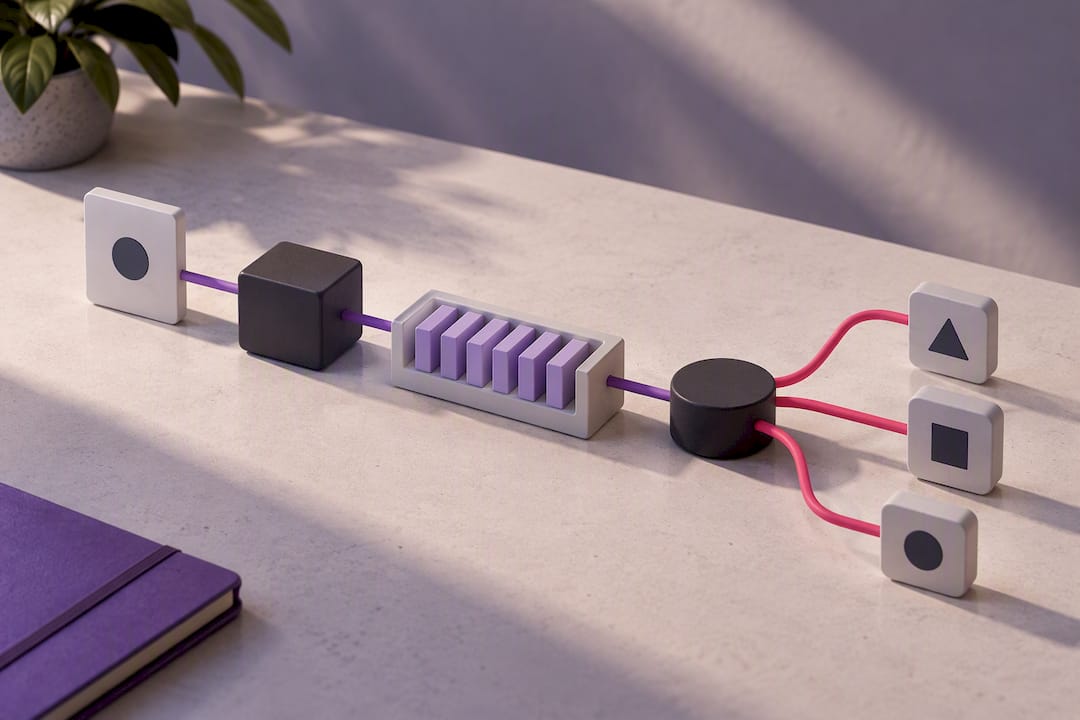
The pattern that shows up again and again in production: receive a webhook, verify it, enqueue it, then let a worker fan the result out to connected clients over WebSockets. It gives you the durability of at-least-once HTTP delivery on the ingestion side and the low latency of a persistent connection on the UI side.
The steps look like this:
- Receive the webhook POST and verify the HMAC signature before touching the payload
- Enqueue the verified event so a slow downstream worker never blocks the HTTP response
- Process the event (update a database record, mark a payment confirmed)
- Publish the result to a pub/sub channel or broker that your WebSocket servers subscribe to
- Push the update to any client connected and interested in that event
This decouples ingestion from delivery, which is exactly the resilience pattern real production systems use: webhooks as the durable inbound mechanism, a broker in the middle, WebSockets as the last-mile delivery to a browser or app. Chaingateway’s event notification webhooks deliver pre-decoded, HMAC-signed payloads across multiple chains, which removes a step from this pipeline since you’re not parsing raw blockchain data before you can act on it.
Default Choices and What to Watch Next
Default to webhooks for anything server-to-server, especially on serverless infrastructure where holding a connection open makes no architectural sense. Default to WebSockets when a human is staring at a screen waiting for something to change in under a second. Most real systems end up combining both rather than picking one dogmatically, and that’s not a compromise, it’s usually the correct design.
Keep an eye on WebTransport and WebSocketStream. Neither has fully displaced WebSockets yet, but both target the backpressure and stream-handling gaps that make raw WebSocket code harder to write correctly than it should be.
— Bitblade
Get Reliable Webhook Delivery Without Building It Yourself
Building the ingestion, verification, and retry logic behind reliable webhooks is real engineering time that most teams underestimate until they’ve shipped it twice. Chaingateway’s blockchain webhooks hand you HMAC-signed, pre-decoded event notifications across Ethereum, Tron, Bitcoin, and other major chains, so the fan-out pattern described above starts from a verified payload instead of raw chain data you have to parse yourself.
That maps directly onto the architecture in this article: Chaingateway handles the webhook ingestion and signing, you handle the queue and the WebSocket fan-out to your users. Plans start with the Plus tier at €49 per month, scaling up to Enterprise for higher volume. If you’re weighing whether to build webhook infrastructure from scratch or wire up a managed feed, check the pricing page and see which tier matches your event volume before you write another retry handler.
Sources
For deeper protocol detail, MDN’s WebSocket client guide covers the connection lifecycle precisely. For webhook delivery mechanics, see Webhooker’s step-by-step breakdown and Twilio’s webhook guide. For the hybrid architecture pattern, WebhookRelay’s comparison is worth the read.
- WebSockets vs. Webhooks: How do they differ? | GetStream
- How Do Webhooks Work? The Actual HTTP, Step by Step — Webhooker
- Webhook vs WebSocket: What’s the Difference? | WebhookRelay
Recommended
Frequently asked questions
Nothing has fully replaced WebSockets yet, but WebTransport and WebSocketStream are emerging alternatives built to handle backpressure and multiplexed streams more cleanly. Browser support is still incomplete, so WebSockets remain the practical default for most real-time features today.
Streaming AI responses in browsers commonly use Server-Sent Events (SSE) for one-way token streaming, since the client mostly just needs to receive, not send, continuous data. Some real-time voice or multi-turn interactive features use WebSockets instead, where bidirectional exchange matters more.
Webhooks require a publicly reachable endpoint, which raises firewall and security considerations, and delivery is typically at-least-once, meaning your handler must tolerate duplicate events. If your endpoint is down when an event fires and retries expire, that event can be lost silently unless you build monitoring around it.
Common examples include payment confirmation notifications, Git push and pull request events, CI/CD pipeline triggers, and deposit or transaction alerts on blockchain networks. Chaingateway’s webhook-based deposit processing is a concrete example of automating fund confirmations without polling a blockchain node.
Chaingateway’s webhook and event notification features are included across its API plans, starting with Plus at €49 per month billed monthly, or €490 annually. Higher tiers (Pro, Premium, Enterprise) scale with usage volume and additional features.
Ready to build this yourself? Get your API key — 7-day trial, no card required — or see the Blockchain API for the full endpoint reference.